
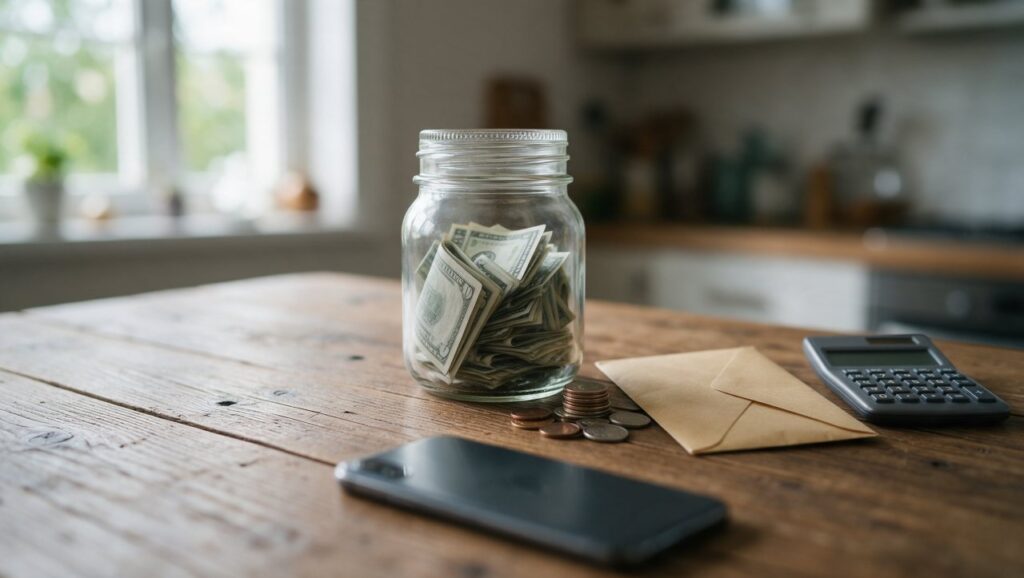
You finally did it. After months of watching your checking account balance hover around the same number, you transferred $5,000 into a separate savings account. It feels good to see that money sitting apart from your daily spending cash. After a few weeks, you check the interest payment. At a low-rate account, it is a few dollars. Maybe less. You start wondering if there is a better way to make that money work without checking a stock chart every five minutes.
That is exactly where a certificate of deposit, or CD, comes in. It is not flashy. It will not make you rich overnight. But it is one of the simplest tools for earning a predictable return on cash you do not need right away. If you have never used one, the rules are easy to learn.
What a CD Actually Is
A certificate of deposit is a type of savings account with a catch. You agree to leave your money with a bank or credit union for a set period, and in return, the institution pays you a fixed interest rate. That period can range from a few months to several years. When the time is up, you get your original deposit back plus the interest it earned.
Think of it as a locked box with a timer. You put cash in, close the lid, and wait. The bank knows you have promised not to grab the money early, so they feel comfortable paying you more than they would on a regular savings account. The trade off is that your money is not easy to reach during the term.
For example, imagine you have $10,000 that you do not plan to touch for two years. You might put it in a 24 month CD. The bank tells you the rate upfront, so you can calculate exactly how much interest you will earn by the end. That predictability is the main reason people choose CDs over other options.
How CD Terms and Interest Work
When you open a CD, you pick a term length. Common options include three months, six months, one year, two years, three years, and five years. Generally, longer terms come with higher rates because you are agreeing to lock up your money for more time. However, that is not always true when the economy is shifting, so you should always compare current offers.
The interest rate is expressed as an annual percentage yield, or APY. The APY tells you how much your money will grow in one year, including the effect of compounding. Compounding means you earn interest on your interest, not just on your original deposit. Most CDs compound daily or monthly, which slightly increases your total return compared to a simple interest calculation.
Let’s say you open a one year CD with a 4.00% APY. If you deposit $5,000, you will have about $5,200 at the end of the year. The exact amount depends on how often the bank credits interest to your account. You can use an online CD calculator to see the precise number before you commit. The key point is that the rate is locked, so your earnings do not change even if the Federal Reserve moves rates up or down after you open the account.
Where to Find CDs
You do not need a special brokerage account to buy a CD. Banks and credit unions offer them directly. You can walk into a local branch or, more often, open one online in about ten minutes. Online banks tend to offer higher rates because they do not have the overhead costs of maintaining physical locations. Credit unions also compete well, especially if you qualify for membership through your job, location, or family connection.
Brokerage firms are another option. Companies like Fidelity, Charles Schwab, and Vanguard allow customers to buy brokered CDs from a variety of banks. Instead of dealing with one bank, you can shop dozens of offers in one place. The rules for brokered CDs are a little different. For example, if you need to get out early, you generally cannot pay a penalty to the bank. Instead, you would sell the CD on a secondary market, and the price could be higher or lower than what you paid.
For a beginner, a direct CD from an FDIC insured bank or NCUA insured credit union is usually the easiest starting point. You know the penalty rules upfront, and you do not have to think about market prices.
Early Withdrawal Penalties and Liquidity
The biggest downside of a CD is simple: your money is stuck. If you need to pay for a car repair or a medical bill, you cannot just transfer from the CD to checking without consequences. You will pay an early withdrawal penalty. The size of that penalty depends on the bank and the term length.
Penalties vary by bank, but a one year CD might charge around 90 days of interest, while a five year CD could charge 180 days or more. In some cases, if you withdraw early during the first few months, the penalty could eat into your principal, meaning you get back less than you deposited. That is rare but worth checking before you open the account.
Because of this, you should only put money in a CD that you are confident you will not need during the term. A good rule is to keep your emergency fund in a high yield savings account where you can access it instantly. Use CDs for separate goals, like a house down payment you plan to make in 18 months or a vacation you are saving for next summer.
CD Ladders: A Simple Way to Stay Flexible
Locking all your savings into one five year CD feels risky. What if rates go up next year? What if you need some cash sooner than expected? A CD ladder solves both problems by splitting your money across multiple terms.
How a basic ladder works
Imagine you have $15,000 to save. Instead of opening one five year CD, you split it into three parts of $5,000 each.
- Put $5,000 in a one year CD.
- Put $5,000 in a two year CD.
- Put $5,000 in a three year CD.
After the first year, your one year CD matures. You can take the cash if you need it, or you can reinvest it in a new three year CD. Once the ladder is running, a CD matures every year, and each new one earns the longer-term rate. This keeps your money more accessible than a single long lockup while capturing better yields over time.
You can adjust the number of rungs based on your comfort level. Some people build a six rung ladder with terms from six months to three years. Others use four rungs of 12, 24, 36, and 48 months. The goal is steady access, not perfect optimization.
When CDs Make Sense
CDs are not the best choice for every goal. They work best when you have a specific time horizon and a low tolerance for losing money. If you know you need $20,000 for a home renovation in two years, a two year CD removes the guesswork. You know exactly what you will have when the project starts.
They also help people who struggle with the temptation to spend. If your savings account is linked to your checking account with one click transfers, it is easy to raid it for a weekend trip. A CD adds friction. The penalty makes you pause. That can be a useful behavioral guardrail even if the interest rate is only slightly better than a savings account.
On the other hand, CDs are a poor fit for long term retirement investing. The returns are too low to beat inflation over decades. For that, you need stocks or stock index funds. CDs are for preserving money you already have, not for growing wealth at a high rate. Keep them for short and medium term cash needs.
Common Mistakes to Avoid
Most CD mistakes come from rushing or not reading the fine print. Here are the big ones to watch for.
Automatic renewal surprises
Most CDs renew automatically when the term ends. The bank gives you a short grace period, often seven or ten days, to make changes. If you do nothing, your money rolls into a new CD with the same term but at whatever rate the bank is offering that day. That rate could be much lower than what you earned before. Mark your maturity date on your calendar and decide ahead of time whether to renew, withdraw, or move the money elsewhere.
Chasing the highest rate without checking the penalty
A bank might advertise an amazing rate but pair it with a brutal early withdrawal penalty. If there is any chance you might need the money, a slightly lower rate with a gentler penalty could be the better deal. Read the disclosure before you click accept.
Putting your emergency fund in a CD
This is the one that causes real pain. Your emergency fund is for job loss, car trouble, or a broken water heater. Those events do not wait for a CD maturity date. Keep at least three to six months of essential expenses in an ordinary savings account. Then use CDs for money above that amount.
Ignoring credit unions
Many beginners only check big national banks. Credit unions often pay competitive rates because they are not-for-profit and return earnings to members. If you are eligible to join one, compare their CD specials before opening an account elsewhere.
Specialty CDs Worth Knowing About
Beyond the standard fixed rate CD, you may see a few variations. They can be useful in specific situations, but they come with extra rules.
No penalty CDs
These allow you to withdraw your full balance after a short waiting period, usually about seven days, without paying any fee. In exchange, the rate is often slightly lower than a traditional CD of the same length. They are a good middle ground if you want a guaranteed return but cannot commit to a strict lockup.
Bump up CDs
A bump up CD lets you request a higher rate once or twice during the term if the bank raises its advertised rates. The starting rate is usually a bit lower than a standard CD. This can be helpful if you think rates will rise but you do not want to wait on the sidelines. The catch is that you have to remember to ask for the bump. The bank will not do it for you automatically.
Step up CDs
With a step up CD, the bank schedules rate increases at set intervals, such as every six months. You know the schedule upfront. These products can be attractive when rates are low but expected to climb, though the overall return may still be similar to a standard CD over the full term. Compare the blended rate before choosing one.
How to Choose the Right CD
Start with your timeline. If you need the money in eight months, do not buy a three year CD just because the rate looks nice. The penalty will wipe out any advantage. Match the term to the date you expect to spend the cash.
Next, compare rates across at least three institutions. Check your current bank, a large online bank, and a credit union. Look at the APY, not the base rate. The APY already accounts for compounding, so it is the fairest number for comparison. Pay attention to the minimum deposit too. Some CDs require $500, others want $1,000 or $2,500. Choose one that fits your balance without stretching.
Finally, read the penalty disclosure. Look for the exact wording about early withdrawal. It will say something like “90 days simple interest on the amount withdrawn.” Make sure you understand how much you would lose in a worst case scenario. If the penalty is unclear or the bank’s customer service cannot explain it, consider going elsewhere.
Quick Checklist Before You Open a CD
- Confirm this money is separate from your emergency fund and you will not need it during the term.
- Choose a term length that matches your savings goal date.
- Compare APYs from at least three FDIC or NCUA insured institutions.
- Read the early withdrawal penalty and calculate the cost of pulling out after six months.
- Check the minimum deposit requirement and make sure you can meet it comfortably.
- Set a calendar reminder for the maturity date at least two weeks before it hits.
- Decide now whether you will withdraw, reinvest, or move the money at maturity.
- Keep a copy of the account disclosure and rate confirmation for your records.
Once you finish that list, opening the CD takes only a few minutes. Then the fixed rate does the rest.